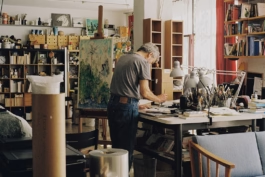
Artist Perico Pastor turned a wine label commission into an exploration of gesture, freedom, and an artist's bond with a beloved land. A conversation about the creative process, l'Empordà, and what it means to be an artist when you never had a choice.
B.S.
What was the process of creating the illustration for the label like?
P.P.
It came naturally — I love l'Empordà, I love wine, and the poem was beautiful. The illustration had to be the background music, not the main act. The image needed a shepherd, the local fauna, a Nereid, the sea — and of course vines and grapes. But the most important thing was making sure the wine's name had its own space. I made many versions and played a lot with the brushes, because with my technique there's no going back: if it doesn't work, you throw it out and start again.
B.S.
What does l'Empordà mean to you?
P.P.
Many things. I'm from l'Alt Urgell, and as a child we'd head south every summer, to Xàbia. I discovered l'Empordà in 1975, the day Franco died, when I settled in Cadaqués for nine months. I'd assumed it was full of posers, but in winter it's the local people, the mountains, the solitude, the painting. It was pure happiness. Later I discovered Calella, Viladamat, Roses...
There's also another Empordà that's very important to me — Josep Pla's. I bought his complete works when I was living in New York and read them slowly, one by one. To immerse yourself in Pla is to truly immerse yourself in l'Empordà.
B.S.
Are you a mountain person or a sea person?
P.P.
I'm very much a mountains person, but my father was from the Valencian coast and our month of holidays in Xàbia were sacred. Back then, children were so much freer: at five I'd go to the harbour on my own; at seven I'd take the train from Barcelona to Puigcerdà alone. Both in the mountains and by the sea, it was a wild life — in the best sense. At Cap de Sant Antoni, at the far end of the Montgó, there's a cliff face 250 metres above the sea. At night, at fifteen, we'd climb that path to a disco and walk back at three in the morning. It seemed perfectly normal.
B.S.
What inspires you to create?
P.P.
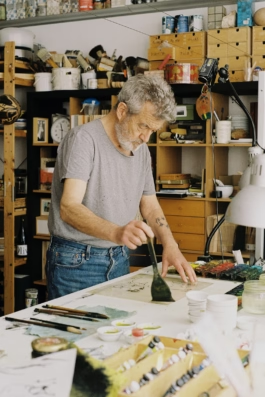
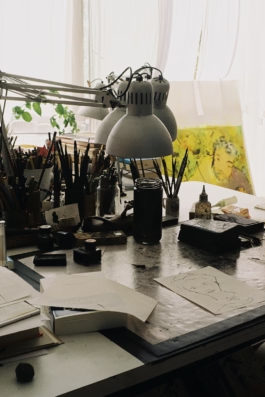
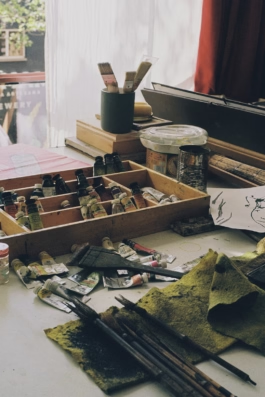
My son Hugo asked me exactly that question once. I told him: what inspires me is the feel of the brush and ink on Japanese paper. I don't wake up thinking "today I'll paint the sunset." I open a drawer, see a piece of paper and think: "that's the one." If Japanese paper, Chinese ink and brushes disappeared, I'd stop painting. My son said: "how pretentious." But it's the truth.
B.S.
Why watercolour, Chinese ink and Japanese paper?
P.P.
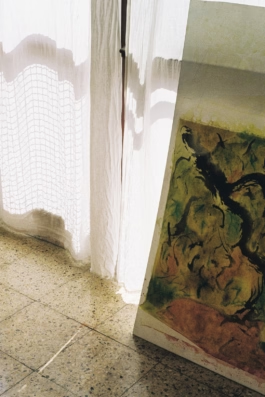
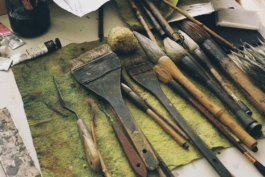
The brush is the most versatile instrument there is. A single stroke and you already have a mouth, an eyebrow, an eyelid — you don't need to draw anything else. I love the calligraphic quality of it: it carries the gesture, it's like an improvised dance with discipline. And besides, I'm lazy: when you finish a watercolour session, you rinse the brushes in thirty-five seconds; with oil you spend half an hour with soap. And watercolour on wet paper gives you effects you only partially control — and I'm perfectly happy letting the painting do what it wants.
B.S.
As a final question, how would you define your relationship with art?
P.P.
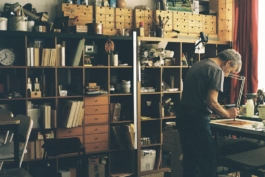
Reluctant. As a child I thought it was all terribly pretentious, but in the end I realised I wasn't good at anything else, so I gave in. People talk about art as if it were the Immaculate Conception, but it's a craft — an activity some people are simply more gifted at than others. Technique is overrated: Van Gogh drew poorly, but that very imperfection is what moves you. Museums are full of people who paint better than him, and you walk straight past. I have a great time doing what I do, and I don't sell my suffering to anyone. Art is for sharing and accompanying — I saw it in the seven-metre corridor I painted at l'Hospital del Mar, and I feel it whenever I paint live in front of an audience.
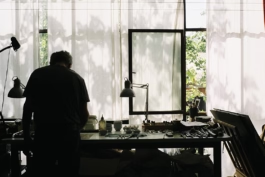
Interview by Basis Studio / Shot on 35mm by Anna 🐼
Artist Perico Pastor turned a wine label commission into an exploration of gesture, freedom, and an artist's bond with a beloved land. A conversation about the creative process, l'Empordà, and what it means to be an artist when you never had a choice.
B.S.
What was the process of creating the illustration for the label like?
P.P.
It came naturally — I love l'Empordà, I love wine, and the poem was beautiful. The illustration had to be the background music, not the main act. The image needed a shepherd, the local fauna, a Nereid, the sea — and of course vines and grapes. But the most important thing was making sure the wine's name had its own space. I made many versions and played a lot with the brushes, because with my technique there's no going back: if it doesn't work, you throw it out and start again.
B.S.
What does l'Empordà mean to you?
P.P.
Many things. I'm from l'Alt Urgell, and as a child we'd head south every summer, to Xàbia. I discovered l'Empordà in 1975, the day Franco died, when I settled in Cadaqués for nine months. I'd assumed it was full of posers, but in winter it's the local people, the mountains, the solitude, the painting. It was pure happiness. Later I discovered Calella, Viladamat, Roses...
There's also another Empordà that's very important to me — Josep Pla's. I bought his complete works when I was living in New York and read them slowly, one by one. To immerse yourself in Pla is to truly immerse yourself in l'Empordà.
B.S.
Are you a mountain person or a sea person?
P.P.
I'm very much a mountains person, but my father was from the Valencian coast and our month of holidays in Xàbia were sacred. Back then, children were so much freer: at five I'd go to the harbour on my own; at seven I'd take the train from Barcelona to Puigcerdà alone. Both in the mountains and by the sea, it was a wild life — in the best sense. At Cap de Sant Antoni, at the far end of the Montgó, there's a cliff face 250 metres above the sea. At night, at fifteen, we'd climb that path to a disco and walk back at three in the morning. It seemed perfectly normal.
B.S.
What inspires you to create?
P.P.
My son Hugo asked me exactly that question once. I told him: what inspires me is the feel of the brush and ink on Japanese paper. I don't wake up thinking "today I'll paint the sunset." I open a drawer, see a piece of paper and think: "that's the one." If Japanese paper, Chinese ink and brushes disappeared, I'd stop painting. My son said: "how pretentious." But it's the truth.
B.S.
Why watercolour, Chinese ink and Japanese paper?
P.P.
The brush is the most versatile instrument there is. A single stroke and you already have a mouth, an eyebrow, an eyelid — you don't need to draw anything else. I love the calligraphic quality of it: it carries the gesture, it's like an improvised dance with discipline. And besides, I'm lazy: when you finish a watercolour session, you rinse the brushes in thirty-five seconds; with oil you spend half an hour with soap. And watercolour on wet paper gives you effects you only partially control — and I'm perfectly happy letting the painting do what it wants.
B.S.
As a final question, how would you define your relationship with art?
P.P.
Reluctant. As a child I thought it was all terribly pretentious, but in the end I realised I wasn't good at anything else, so I gave in. People talk about art as if it were the Immaculate Conception, but it's a craft — an activity some people are simply more gifted at than others. Technique is overrated: Van Gogh drew poorly, but that very imperfection is what moves you. Museums are full of people who paint better than him, and you walk straight past. I have a great time doing what I do, and I don't sell my suffering to anyone. Art is for sharing and accompanying — I saw it in the seven-metre corridor I painted at l'Hospital del Mar, and I feel it whenever I paint live in front of an audience.
Interview by Basis Studio / Shot on 35mm by Anna 🐼